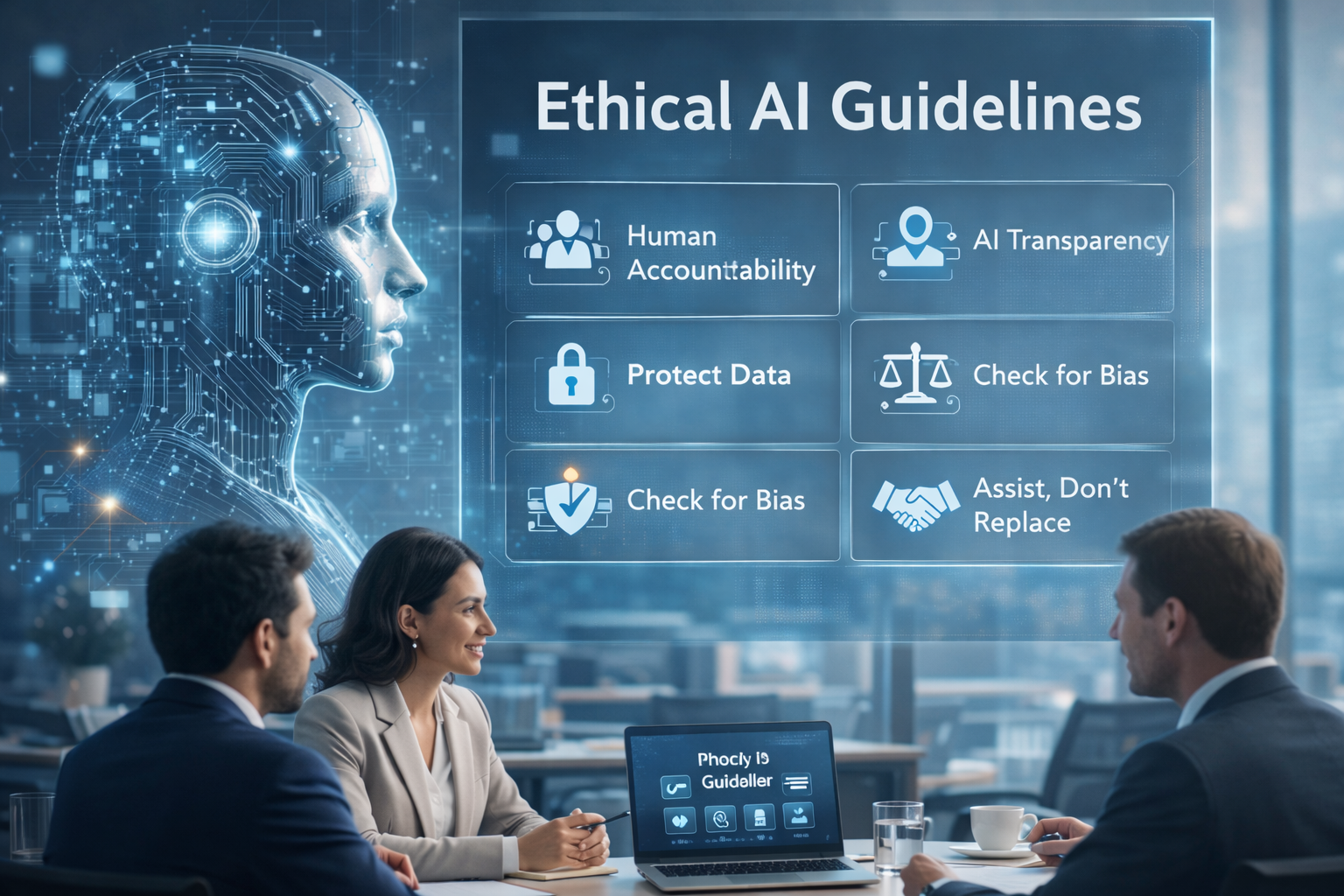
I didn’t start worrying about AI ethics because of regulations or headlines.
I started worrying the first time a manager said to me, “The AI flagged this employee as low-performing, so we’re moving forward.” No discussion. No context. No human pause.
That moment made something clear: the ethics of AI in the workplace isn’t a future problem. It’s already here. By 2026, the shift from AI as a “tool” to AI as an “autonomous agent” means companies that ignore ethics won’t just face legal risk—they’ll lose their most valuable asset: Trust.
I’ve worked closely with teams using AI for hiring, content review, and productivity tracking. When AI is used well, it sharpens thinking. When it’s used carelessly, it quietly erodes fairness. This article is a practical framework for the 2026 workplace.
The 2026 Reality: Why Ethics Is Now a Compliance Issue
As of August 2, 2026, the EU AI Act has officially moved into its full enforcement phase for high-risk systems. This isn’t just for European companies; it affects any global firm doing business with EU citizens. If your company uses AI to screen resumes or monitor workers, you are now legally required to maintain a Human-in-the-Loop (HITL) system and provide transparency.
Failure to follow these ethical guidelines can now result in fines up to €35 million or 7% of global turnover. Ethics is no longer a “feel-good” PR move; it is a survival strategy.
Guideline #1 — Humans Must Stay Accountable (Human-in-the-Loop)
Never Let AI Be the Final Decision-Maker.
This is the core of the 2026 ethical standard. AI should support decisions—not replace them—especially in:
- Hiring and Promotions: Resumes filtered by AI must have a human “sanity check.”
- Termination or Disciplinary actions: You cannot fire someone based on an AI productivity score alone.
The most dangerous phrase I hear is: “The system decided.” In 2026, that is called Accountability Abdication. Ethical companies make it clear: AI suggests, but a human signs off.
Guideline #2 — Categorize Your Tools Using the 2026 Risk Framework
Not all AI tools carry the same ethical weight. To manage a team effectively, you must understand the four levels of risk.
Table: Workplace AI Risk Classification (2026)
| Risk Level | Type of Tool | Ethical/Legal Obligation | Example |
| Unacceptable | Emotion recognition at work | PROHIBITED | AI that “scans” if an employee is happy/sad. |
| High Risk | HR Recruitment / Performance | Strict Oversight Required | AI that filters CVs or ranks staff. |
| Limited Risk | Customer Chatbots / Content | Transparency Required | AI-generated blog posts or support bots. |
| Minimal Risk | Spam filters / Scheduling | No specific obligations | Outlook/Gmail filters or AI calendars. |
Guideline #3 — Protect “Internal” Privacy with the Same Rigor as “Customer” Privacy
Internal Data Is Not “Low Risk.”
Many companies obsess over customer privacy but treat employee data casually. Employee data in 2026 includes:
- Behavioral signals: How fast an employee responds to messages.
- Sentiment data: The “tone” of internal emails.
The Ethical Line: If you wouldn’t explain the data use face-to-face to your staff, it shouldn’t be in the AI system. Ensure you have an “Opt-Out” policy for employees who do not want their behavioral patterns used for “predictive” performance modeling.
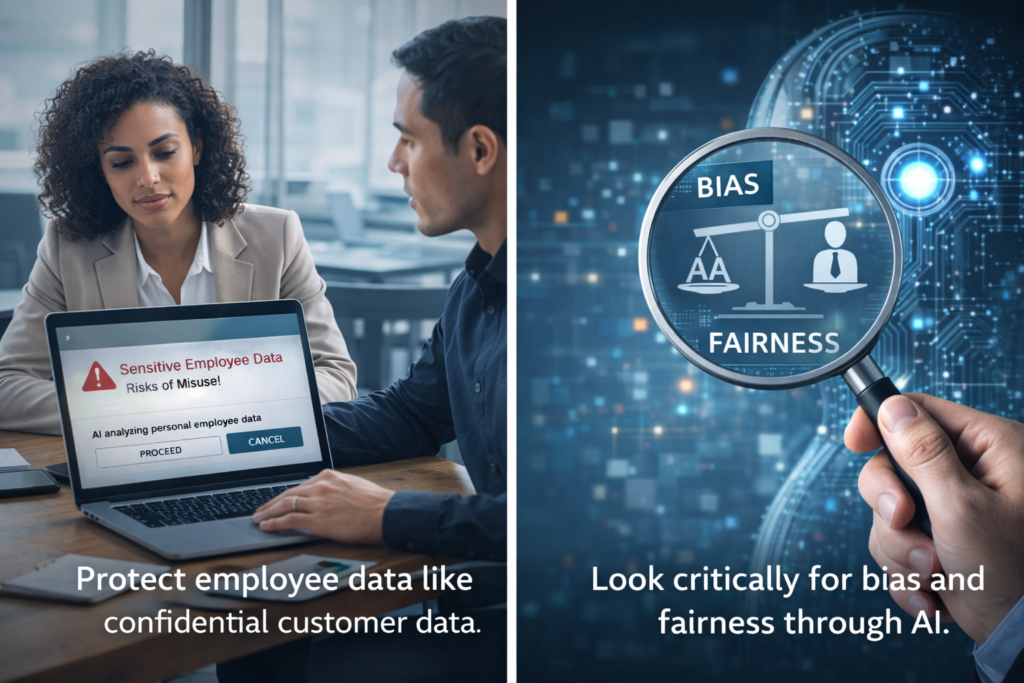
Guideline #4 — Audit for “Algorithm Drift” and Bias
AI Reflects the Past, Not Fairness.
AI learns from historical data. If your company’s past hiring was biased, the AI will amplify that bias.
- Simple Bias Check: You don’t need a data science team. Start with a quarterly review. Compare the AI’s “Top Picks” for candidates against the actual diversity of your applicant pool.
- Algorithm Drift: In 2026, we know that AI models change over time as they process new data. An ethical company audits its AI tools every 3–6 months to ensure the “logic” hasn’t shifted toward unfairness.
Guideline #5 — Use AI to Assist, Not Replace, Human Judgment
Where AI Shines:
- Summarizing 50-page reports into 5 bullet points.
- Spotting patterns in technical logs or financial data.
- Brainstorming “Devil’s Advocate” positions for a new strategy.
Where AI Should Never Lead:
- Conflict Resolution: A bot cannot “mediate” a dispute between two employees.
- Moral Judgment: AI doesn’t understand “intent.” It only understands “output.”
- Cultural Vibe Checks: Identifying “culture fit” is a deeply human intuition that AI consistently gets wrong.
Pro-Tip: The “Front Page” Ethical Test
Before rolling out any AI-driven performance tracking or hiring tool, ask:
“If this AI decision-making process was leaked on the front page of a major news site, would our leadership team be proud to defend it?”
If the answer is “We’d have to explain it away,” the system isn’t ethical enough for 2026.
Final Thoughts: Building a Partner, Not a Liability
The ethics of AI in the workplace isn’t about looking good—it’s about building a sustainable culture. By 2026, your employees are AI-literate. They know when they are being “gamed” by a system.
If your company gets ethics right, AI becomes a partner that removes the “drudge work” and lets people be more human. If not, it becomes a legal and cultural liability that will take years to fix.
