A few months ago, I ran a small test.
I asked three different AI writing tools to generate the same article about marketing automation. Same prompt. Same topic. Same instructions.
The result?
All three pieces sounded almost identical.
The sentences were technically correct. The structure was clean. The information wasn’t wrong. But something felt… empty.
No personality. No perspective. No voice.
If you’ve worked with AI writing tools long enough, you’ve probably noticed this too. Content that looks polished on the surface but reads like it could belong to any brand.
That’s when I realized the real issue.
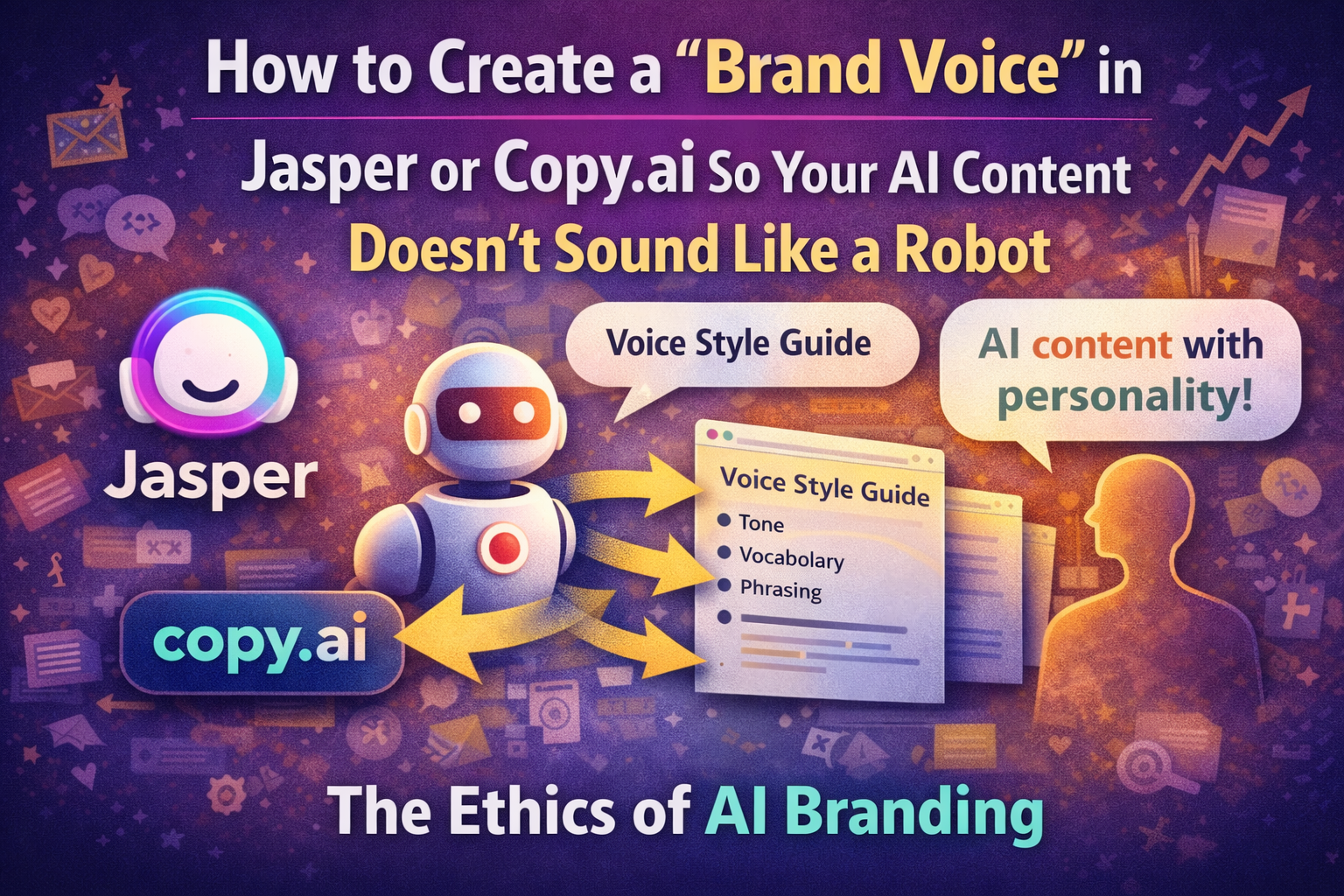
AI doesn’t automatically know your brand voice. You have to teach it.
Once I started experimenting with voice training in tools like Jasper and Copy.ai, the difference was dramatic. The content stopped sounding generic and started sounding much closer to the way I naturally write.
If you’re using AI to produce content, learning how to define and apply a brand voice isn’t optional anymore. It’s becoming part of what I call The Ethics of AI Branding—maintaining authenticity even when machines help write the words.
Let’s break down how to do it.
Why AI Content Often Feels Robotic
There’s a reason AI-generated content tends to feel repetitive.
Most tools operate with a default writing style that is:
- neutral
- informative
- broadly applicable
That makes sense. These models are trained on huge amounts of text from many sources. Without specific direction, they produce something designed to fit almost any audience.
But for brands, that neutrality becomes a problem.
Imagine visiting five different blogs and noticing that every article sounds strangely similar.
Readers notice. Even if they can’t explain why.
The issue usually isn’t the information. It’s the missing identity behind the writing.
This is where The Ethics of AI Branding comes into play.
When brands use AI to produce content, they still have a responsibility to maintain their voice, perspective, and authenticity.
Otherwise, the internet becomes filled with indistinguishable content.
Read Also: A Guide on Using the -cref (Character Reference)
What a “Brand Voice” Actually Means Today
Brand voice is often misunderstood.
It’s not just the tone of your writing.
It’s the personality of your communication.
Your brand voice includes several elements:
- tone and emotional attitude
- vocabulary and phrasing
- storytelling style
- sentence structure
- level of formality
Two companies could write about the same topic and sound completely different.
For example:
A software company might sound analytical and technical.
A creator-focused brand might sound casual and conversational.
A consulting firm might sound authoritative and strategic.
AI tools can replicate these voices—but only if you provide clear instructions.
Without those instructions, the output falls back to the safe, generic style most AI models use.
Why Jasper and Copy.ai Need Voice Training
AI writing tools don’t automatically understand brand identity.
They respond to prompts.
If the prompt is vague, the output becomes generic.
But when you provide structured guidance—tone, examples, style rules—the results improve significantly.
How AI Generates Default Writing
Most AI systems generate text by predicting the most likely next word based on context.
That means they gravitate toward patterns that appear frequently across the internet.
Which explains why many AI-generated articles contain phrases like:
- “In today’s digital world…”
- “Businesses must adapt…”
- “This strategy helps companies grow…”
Technically correct. But painfully predictable.
Why Brand Voice Prompts Improve Output
When you provide:
- tone instructions
- writing examples
- vocabulary preferences
the AI has a clearer pattern to follow.
Instead of imitating the average internet article, it starts imitating your writing style.
This shift alone can transform AI-generated content from generic to distinctive.
Read Also: How to Take a DALL-E 3 Image and Turn It Into a High-Quality SVG
Jasper vs Copy.ai: Brand Voice Features
| Feature | Jasper | Copy.ai |
|---|---|---|
| Brand voice memory | Strong | Medium |
| Custom tone settings | Yes | Yes |
| Workflow automation | Advanced | Moderate |
| Collaboration tools | Strong | Good |
| Best use case | Content teams | Solo creators |
Both tools support voice customization, though Jasper tends to provide slightly deeper control for larger content teams.
Step-by-Step: Creating a Brand Voice in Jasper
When I first tested Jasper’s brand voice features, I noticed something important.
The tool performs best when you treat it like a writer you’re training, not just a generator.
Step 1: Define Your Brand Personality
Start by describing your brand in simple terms.
Examples might include:
- expert but approachable
- analytical and data-driven
- casual but insightful
- confident and opinionated
This description becomes the foundation of the AI’s writing behavior.
Step 2: Provide Real Writing Examples
AI learns patterns best through examples.
Upload or paste several samples of your existing content:
- blog articles
- newsletters
- landing page copy
These examples help the system recognize your typical phrasing and rhythm.
Step 3: Set Style Rules
Next, create simple writing rules.
For example:
- keep sentences short
- avoid corporate buzzwords
- explain complex ideas using simple language
These constraints guide the AI toward more consistent outputs.
Step 4: Test and Refine
Voice training isn’t a one-time process.
Generate multiple drafts. Compare them. Adjust instructions.
After a few iterations, the output usually starts sounding far closer to your natural writing style.
Creating a Brand Voice in Copy.ai
Copy.ai approaches brand voice slightly differently.
The workflow is simpler, but still effective.
Step 1: Activate the Brand Voice Feature
Copy.ai allows you to create voice profiles within the platform.
These profiles store your tone preferences and writing guidelines.
Step 2: Upload Reference Content
Just like with Jasper, providing real examples improves results.
Good examples include:
- previously published blog posts
- marketing emails
- product descriptions
The AI studies these patterns and applies them to new content.
Step 3: Adjust Tone Prompts
Copy.ai works well when you combine the brand voice profile with clear prompts.
Examples might include:
- “Write in an expert but conversational tone.”
- “Explain ideas clearly without sounding academic.”
Small prompt adjustments often produce noticeable improvements.
Example: Turning Generic AI Content Into Brand Voice Content
Let’s look at a quick example.
Topic: Benefits of AI marketing tools
Generic AI output might read like this:
AI marketing tools help businesses improve efficiency, automate workflows, and increase productivity across multiple channels.
Now compare that with a voice-driven version:
AI marketing tools can save hours of repetitive work. Instead of manually scheduling campaigns or analyzing spreadsheets, teams can focus on strategy while automation handles the routine tasks.
The difference isn’t the information.
It’s the personality behind the words.
My Real Test Training AI With Brand Voice
When I tested both Jasper and Copy.ai with brand voice examples, the results were surprisingly different.
Jasper adapted quickly when provided with longer writing samples. After several iterations, the output started matching my sentence structure and tone closely.
Copy.ai required slightly more prompt refinement but still produced strong results once the voice profile was established.
In both cases, editing time dropped significantly.
Instead of rewriting entire paragraphs, I mostly adjusted small phrasing details.
For anyone publishing content regularly, that time savings adds up quickly.
The Ethics of AI Branding
There’s an important conversation happening around AI content.
If machines can generate endless text, what stops the internet from becoming an ocean of identical articles?
This is where The Ethics of AI Branding matters.
Using AI responsibly means maintaining:
- authenticity
- transparency
- originality
Brand voice plays a critical role here.
It ensures your content reflects real ideas and perspectives, not just automated text generation.
Readers trust brands that sound human.
Even when AI assists the writing process.
Pro Tip
Create a voice style guide before using AI tools.
This guide should include:
- preferred vocabulary
- banned phrases
- sentence length preferences
- tone guidelines
When you provide these details to AI tools, the output improves dramatically.
Think of it as training a new writer on your team.
Common Mistakes When Creating AI Brand Voice
Several mistakes appear frequently when teams attempt to implement brand voice.
These include:
- giving vague tone instructions
- providing no writing examples
- changing prompts constantly
- skipping the editing process
Consistency is key.
The clearer your instructions, the better the AI performs.
Who Should Care About Brand Voice in AI Content
Brand voice matters for many types of organizations.
Especially:
- bloggers building authority
- SaaS companies publishing thought leadership
- marketing agencies producing client content
- founders developing personal brands
- content teams scaling production
If readers can’t recognize your voice, your content becomes interchangeable with everyone else’s.
And that’s not a good place for a brand to be.
Why Brand Voice Will Define the Future of AI Content
AI writing tools are improving quickly.
Soon, producing content won’t be the difficult part.
Standing out will be.
As more brands adopt AI, differentiation will depend less on production speed and more on identity.
The companies that succeed will be the ones that combine automation with authentic communication.
Which brings us back to the core idea behind The Ethics of AI Branding.
AI can help write the words.
But your voice—the perspective, personality, and values behind those words—still belongs to you.
