I’ve spent the last couple of years living inside large language models.
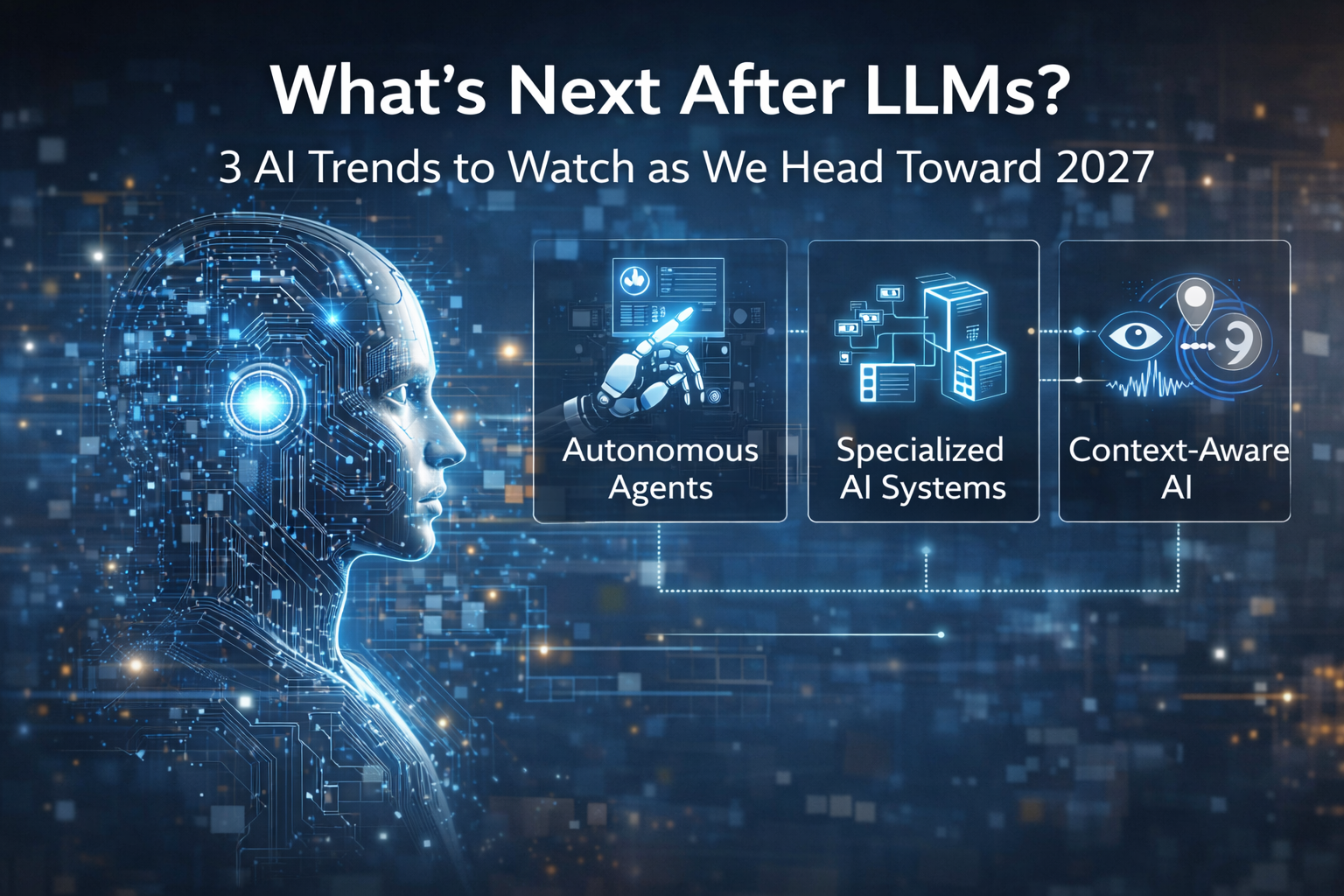
Testing them. Breaking them. Shipping work with them. Watching teams fall in love—and then quietly hit limits. That’s why I’m comfortable saying this out loud: LLMs aren’t the end of the AI story. They’re a chapter. A big one. But by 2027, the most important AI systems won’t feel like chatbots at all.
When people ask me about the future of AI in 2027, they usually expect bigger models, smarter answers, and flashier demos. What’s actually coming is subtler—and far more disruptive. Let’s talk about what’s next, without the hype.
Why Large Language Models Aren’t the End of the Story
LLMs Solved Language—Not Intelligence
LLMs are excellent at one thing: predicting the next “token” based on patterns in data. That’s powerful, but it’s narrow. They speak fluently, but they don’t know. As we move deeper into 2026, the ceiling of “just talking” has become obvious. We don’t need models that talk more; we need systems that do more.
Trend #1 — The Rise of “Agentic AI” (From Assistants to Agents)
The biggest shift heading into 2027 is the transition from Generative AI to Agentic AI.
The Difference:
- Assistants (Today): You give a prompt; it gives a response. It waits for you.
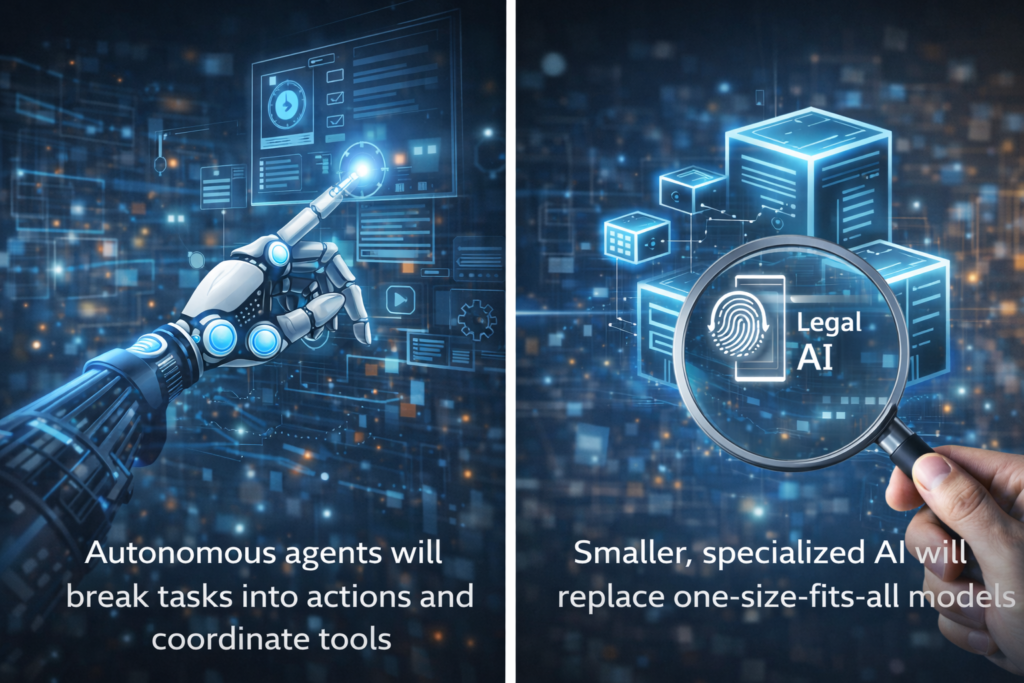
- Agents (2027): You give a goal; the agent plans the steps, uses tools (like your email, CRM, or browser), and completes the task autonomously.
By 2027, Gartner predicts that autonomous agents will be a top-tier enterprise priority. Instead of chatting with a bot to write an email, an “Agentic Workflow” will monitor your inbox, cross-reference your calendar, draft the reply, and send it—only asking you for a “thumbs up” on high-stakes items.
Trend #2 — SLMs (Small Language Models) Beat Massive Models
The era of “Bigger is Better” is ending. While GPT-4 and its successors are impressive, they are expensive, slow, and energy-hungry. By 2027, the trend is Specialization over Generalization.
The Rise of Purpose-Built AI
Companies are realizing they don’t need a model that knows “everything about the world” to process an insurance claim. They need a Small Language Model (SLM) that is:
- Domain-Specific: Trained only on legal, medical, or engineering data.
- On-Device: Small enough to run on a smartphone or local laptop without sending data to the cloud (massive for privacy).
- Cost-Efficient: 10x cheaper and 5x faster than giant LLMs.
Prediction: By 2027, organizations will use task-specific SLMs three times more than general-purpose LLMs.
Trend #3 — Multimodal “Spatial Intelligence” & Context
Today’s AI is mostly trapped in a text box. By 2027, AI will be Natively Multimodal. It won’t just “read” your text; it will “see” through your camera and “understand” the physical context of your environment.
What this looks like in 2027:
- Manufacturing: AI that watches a technician and whispers through an earpiece if they miss a step in a complex assembly.
- Real-Time Context: AI that doesn’t just know what you said in a meeting, but recognizes the tone of the room and the visual data on the whiteboard.
Comparison Table: Today’s AI vs. 2027 AI
| Feature | Today (LLM Era) | 2027 (Agentic Era) |
| Primary Interface | Chat / Prompts | Invisible / Goal-driven |
| Model Size | Massive & Centralized | Small, Specialized & Edge-based |
| Input Type | Mostly Text/Code | Multimodal (Video, Audio, Sensor) |
| Action Level | Reactive (Responds) | Proactive (Acts & Orchestrates) |
| Energy Impact | High Carbon Footprint | Efficient / Optimized “Superfactories” |
The “Accountability Gap”: The Hidden Risk of 2027
The most important question of 2027 won’t be “How powerful is the AI?” but “Who is accountable when the Agent makes a mistake?”
When an autonomous agent schedules a flight, handles a refund, or updates a patient record, the “Prompt Engineer” role disappears and is replaced by the “AI Auditor.” Humans will shift from creators of content to overseers of autonomous systems.
Pro-Tip: How to Prepare for the Post-LLM Era
Don’t get too attached to “Prompt Engineering.” By 2027, the AI will be smart enough to understand your intent without you needing to be a “prompt wizard.”
Instead, focus on:
- System Thinking: Learn how to connect different tools together.
- Data Governance: AI Agents are only as good as the data they can access.
- Governance: Build “Human-in-the-Loop” checkpoints now, so your autonomous future doesn’t become a legal nightmare.
The Real Shift is Subtle—but Massive
The future isn’t about AI becoming “conscious.” It’s about AI becoming useful infrastructure. Just like we don’t think about the electricity in our walls, by 2027, we won’t “think” about using AI. It will simply be the invisible layer that makes our work—and our lives—actually work.
