If you’re using AI images for business in 2026, you’re likely not worried about “artistic expression.” You’re worried about risk.
As a business owner, your questions are practical and legal:
- Can I use this image in my Facebook ads? * Can I put it on a billboard? * What if the AI accidentally generates something that looks like a Disney character? * Who actually owns the copyright if a client sues?
I have tested both Midjourney and DALL-E 3 for real-world commercial work—including ad creatives, website hero images, and product mockups. While both are powerful, the answer to which is “safest” isn’t found in the pixels. It’s found in the terms of service, the privacy controls, and the built-in safety guardrails.
Why “Commercial Safety” is the #1 Business Concern
In 2026, the AI image landscape has shifted from “wonder” to “regulation.” We are no longer in the “Wild West” era of 2023. Courts have begun to weigh in on AI ownership, and platforms have updated their terms to reflect new legal realities.
When we talk about safety for your brand, we are looking at three specific pillars:
- License Clarity: Does the platform explicitly grant you commercial rights?
- Trademark/Copyright Infringement: How easily can you accidentally generate a “look-alike” of a protected brand?
- Operational Privacy: Is your work hidden from competitors, or is it being generated in a public feed?
DALL-E 3: The “Compliance-First” Choice
If you want the “safety-first” tool, DALL-E 3 (integrated into ChatGPT Plus and Microsoft Copilot) has a very strong argument for being the industry standard for low-risk business use.
Ownership and OpenAI Terms
OpenAI’s 2026 Terms of Use are the cleanest in the industry. They state that you own the Output (the generated image) to the extent permitted by applicable law. This means that as far as the platform is concerned, the rights are yours to use for ads, merch, or websites.
Built-in Guardrails
When testing DALL-E 3, you will notice it is much “stricter” than Midjourney. If you ask for a “mouse in a red shirt that looks like a famous cartoon,” DALL-E 3 will likely refuse the prompt.
- Why this is good for business: It prevents your marketing team from accidentally creating a trademark disaster. DALL-E 3 has a high “Refusal Rate” for copyrighted characters, celebrity likenesses, and protected brand logos.
The 2026 “Watermark” Standard
DALL-E 3 now automatically embeds C2PA metadata and invisible watermarks into every image. While some artists hate this, businesses love it. It provides a “provenance trail” that shows the image was AI-generated, which is becoming a legal requirement for political and social ads in many countries.
Midjourney: The Creative Powerhouse (With Responsibility)
Midjourney is widely considered the most “artistic” tool. It creates cinematic, high-texture visuals that DALL-E 3 often can’t match. However, it requires the user to be their own “Legal Department.”
Ownership Rights
Midjourney’s documentation confirms that you own the assets you create. However, there is a catch: if you are a company making more than $1,000,000 USD in gross revenue per year, you must be on the “Pro” or “Mega” plan to own the commercial rights. Using a basic $10/month plan for a corporate brand is a major compliance risk.
The Privacy Problem (Stealth Mode)
By default, Midjourney is a social platform. Everything you generate is visible on the Midjourney website for others to see—and even “remix.”
- The Risk: If you are working on a secret product launch or a confidential client pitch, a competitor could find your images in the public gallery.
- The Solution: To be safe, businesses must use Stealth Mode (available on higher-tier plans). This ensures your generations stay private.
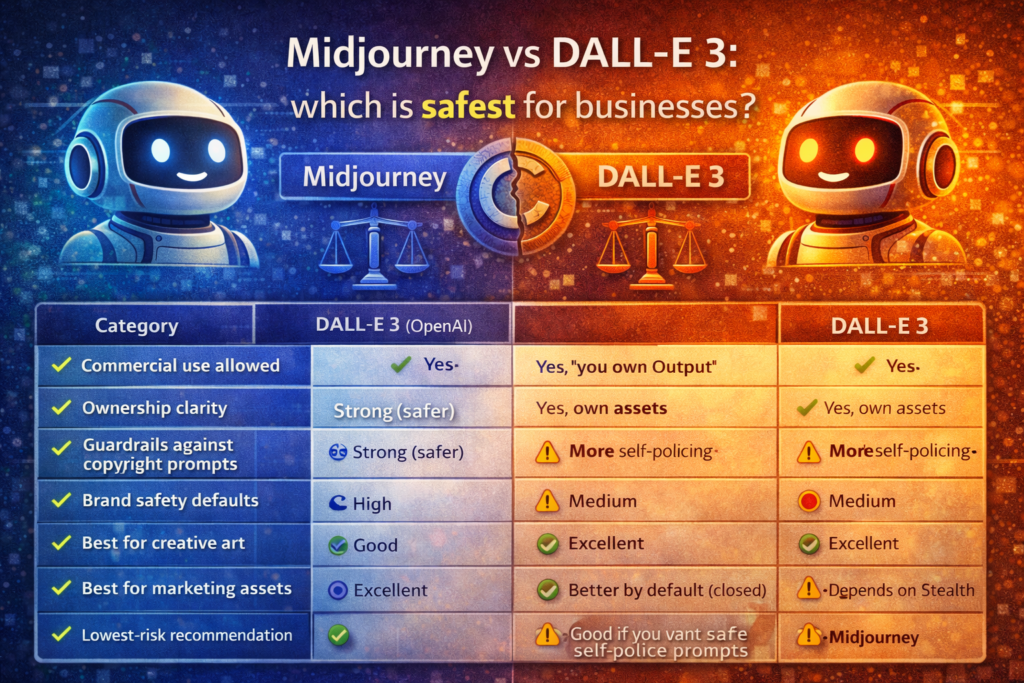
Side-by-Side: Commercial Comparison Table
| Feature | DALL-E 3 (OpenAI) | Midjourney (v6.5+) |
| Commercial Rights | Included in all paid plans | Included (Pro plan required for $1M+ revenue) |
| Copyright Guardrails | Aggressive (Blocks risky prompts) | Moderate (Relies on user discretion) |
| Privacy | Private by default | Public by default (Stealth Mode required) |
| Legal Indemnity | Offered to Enterprise users | Limited |
| Best For | Marketing, Social Media, Quick Ads | High-end Branding, Cinematic Visuals |
2026 Case Study: The “Style IP” Lawsuit Trend
In late 2025 and early 2026, we saw a rise in “Style IP” lawsuits. This is where a brand doesn’t sue because you copied a character, but because you copied their aesthetic.
The Experiment: I prompted both tools to create “A soft-drink advertisement in the style of a famous 1950s illustrator.”
- DALL-E 3 modified the prompt to be more generic, avoiding a direct copy of the artist’s unique “hand.”
- Midjourney produced an image that looked almost exactly like the artist’s work.
The Verdict: If you use Midjourney, you must be careful not to name specific living artists in your prompts. This is the #1 way businesses are getting into legal trouble today.
How to Stay “Business Safe” (The 2026 Checklist)
Regardless of which tool you choose, follow this checklist to protect your brand:
- Describe, Don’t Name: Instead of “In the style of Wes Anderson,” use “Symmetrical composition, pastel colors, whimsical atmosphere, and flat lighting.”
- Avoid Celebrities: Never use a real person’s name in a commercial prompt. Use descriptions like “A middle-aged man with professional attire” instead.
- Check for “Stealth Mode”: If using Midjourney, ensure your
/settingsare set to Private/Stealth. - Keep a Prompt Log: Save your prompts. If a copyright issue ever arises, you can prove you didn’t intend to infringe on a specific trademark.
- Reverse Image Search: Before running an AI image in a high-budget ad campaign, run it through Google Lens or TinEye to ensure it isn’t too similar to an existing copyrighted work.
Frequently Asked Questions
Can I trademark an AI-generated logo?
In most jurisdictions (including the US and EU), you currently cannot copyright an image created entirely by AI. However, if you use the AI image as a base and then significantly modify it in Photoshop, you may be able to claim “Human Authorship.”
Is Midjourney or DALL-E 3 better for Print-on-Demand (POD)?
Midjourney typically offers higher resolution and better textures for physical products. However, DALL-E 3 is safer if you are worried about accidentally infringing on pop-culture icons (which is the main reason POD accounts get banned).
Do I need to disclose that my images are AI-generated?
In 2026, transparency is becoming a best practice. Many social media platforms (like Instagram and TikTok) now have an “AI-Generated” label that you are required to toggle if the content looks photorealistic.
Final Take: Which is Safest?
If you are an agency, a corporate marketing team, or a small business that wants a “set-and-forget” tool with the lowest legal risk, DALL-E 3 is the winner. Its aggressive guardrails protect you from your own mistakes.
If you are a creative director or a high-end designer who understands copyright law and needs the absolute best artistic quality, Midjourney is the winner—provided you pay for the Pro plan and keep your work in Stealth Mode.
