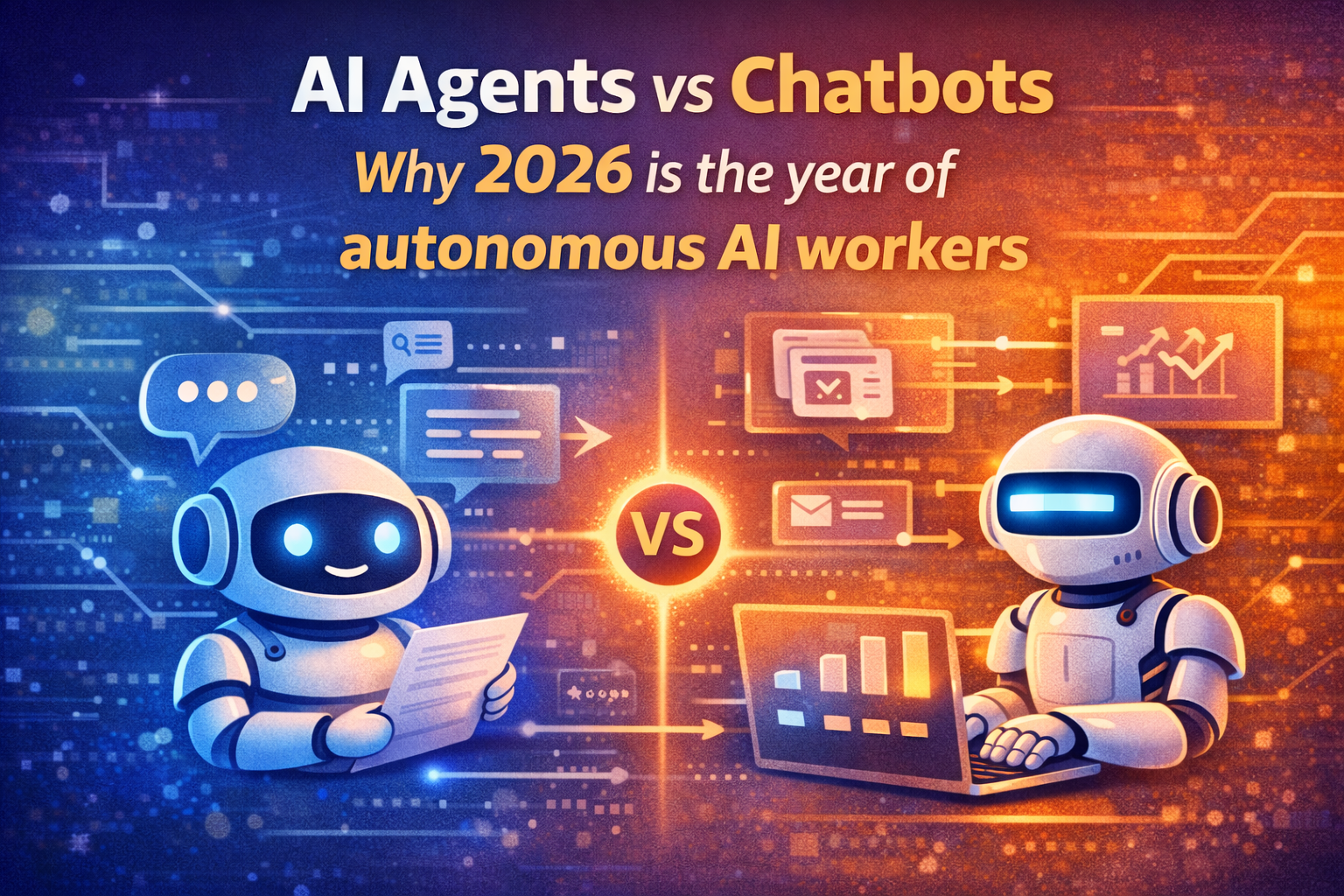
If 2024 was the year the world discovered chatbots, then 2026 is shaping up to be something else entirely. We are witnessing a fundamental shift in how humans interact with technology. We’re not just “talking” to AI anymore; we are handing it the keys to our digital workflows.
We are handing it tasks—real, complex, multi-step tasks. The boring ones. The repetitive ones. The ones that quietly consume half of your workday while you tell yourself you’ll “get to them later.”
I used to think all this “AI agents” talk was just marketing fluff—a fancy rebrand of a chatbot with a slightly better system prompt. But after building and testing several real-world agentic workflows—covering email triage, lead follow-ups, and client onboarding—I am convinced: AI agents are a completely different category. They aren’t just smarter chatbots; they are early-stage digital workers.1
The Industry Confusion: Chatbots vs. Agents
Right now, the term “AI agent” is being thrown around like confetti.2 People are labeling everything an agent: a chatbot with a memory, a GPT with a custom UI, or a simple script that sends an automated reply.
To understand the 2026 landscape, we have to fix the definition.
What People Think Agents Are
Most people describe them using vague terms:
- “It’s like ChatGPT, but it works for you.”
- “It’s a chatbot that actually does stuff.”
- “It’s total automation.”
While these descriptions capture the feeling of using an agent, they miss the technical reality.
What AI Agents Actually Are (The 2026 Definition)
In plain English, an AI Agent is a software system that can:
- Understand a Goal: You give it an objective (e.g., “Find and book a flight for my business trip”), not a line-by-line instruction.
- Plan the Steps: It breaks that goal into smaller, logical sub-tasks.
- Use Tools: It interacts with apps, APIs, browsers, and CRMs.
- Make Decisions: It evaluates information and chooses the next best action.
- Self-Correct: If a tool fails or a step doesn’t work, it tries a different path until the job is done.
The Golden Rule of 2026: If a chatbot is conversation-driven, an agent is outcome-driven.
Why 2026 is the Turning Point
You might wonder why this shift didn’t happen in 2024. The truth is, the technology wasn’t ready. Three major pillars finally matured to make 2026 the “Year of the Agent”:
1. Models Got Cheaper and Faster
In 2024, running an “agentic loop” (where an AI thinks and acts repeatedly) was prohibitively expensive and slow. With the release of models like Gemini 1.5 Pro and Claude 3.5, “tool-calling” is now instantaneous and costs a fraction of what it used to.
2. The Automation Stack is Integrated
In the past, AI lived in a vacuum. Today, tools like Zapier, Make, and n8n have created “hooks” into thousands of apps.3 Agents now have “hands” to work with—they can reach into your Slack, your Quickbooks, or your Shopify store with ease.
3. The Cultural Acceptance of AI
Two years ago, business owners were afraid of AI mistakes. In 2026, the mindset has shifted. Companies are no longer asking if they should use AI; they are asking, “What is the next manual workflow we can hand off to an agent?”
Read Also: 10 Microsoft Copilot Prompts That Will Make You an Excel Expert
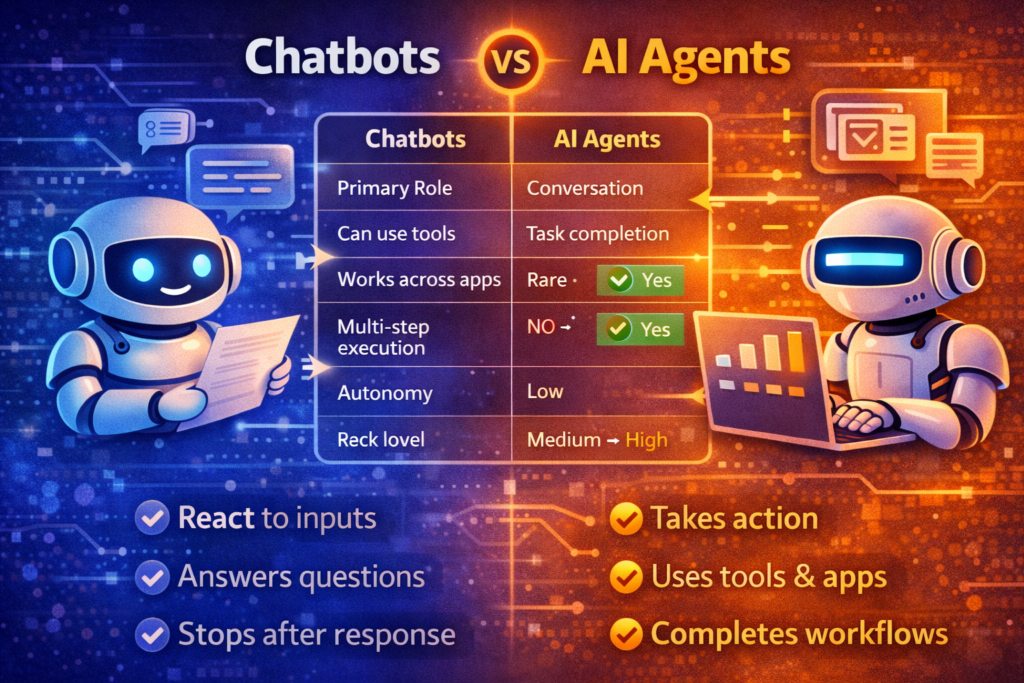
Comparison Table: Chatbots vs. AI Agents
| Feature | Chatbots (2024 Style) | AI Agents (2026 Style) |
| Primary Goal | Communication & Q&A | Task Execution & Completion |
| Action Level | Reactive (Waits for you) | Proactive (Takes next steps) |
| Tool Usage | Very Limited | High (Browsers, APIs, Apps) |
| Workflow | Single-turn response | Multi-step loops |
| Autonomy | Zero (Needs constant prompts) | High (Needs a single goal) |
| Best Use Case | Customer Support / FAQ | Operations / Digital Logistics |
Case Study: The “Midnight Lead” Scenario
To prove why this matters, let’s look at a real-world case study from my own testing.
The Problem: An agency owner receives a high-value inquiry at 11:43 PM on a Friday. Usually, that lead sits in the inbox until Monday morning. By then, the lead has likely contacted three other competitors.
The Chatbot Approach: A chatbot might send an auto-reply: “Thanks for your email! We will get back to you on Monday.” This is polite but adds zero value.
The AI Agent Approach: My agent (built using Claude and Zapier) performed the following loop:
- Identify Intent: It recognized the email was a “High-Value Web Design Inquiry.”
- Research: It searched the lead’s company URL to understand their industry.
- Qualify: It checked my calendar for availability.
- Execute: It drafted a personalized reply mentioning their specific industry, attached my portfolio, and suggested two specific meeting times.
- Alert: It sent a Slack notification to my phone: “High-value lead triaged and drafted. Review when you wake up.”
The Result: I woke up, spent 30 seconds reviewing the draft, and hit send. The lead booked the meeting before my competitors even opened their laptops. Speed plus relevance wins in 2026.
The 5-Step Agent Loop: How They Think
If you want to build your own agents, you need to understand their “brain” logic. Most 2026 agents follow this recursive loop:
- Step 1: Perception: The agent receives the goal and the current context.4
- Step 2: Planning: It lists the tools it needs (e.g., “I need the Search tool and the Email tool”).5
- Step 3: Action: It executes the first step (e.g., searching for a price).
- Step 4: Observation: It looks at the result. Did it find the price? If not, it tries a different search.
- Step 5: Completion: Once the goal is met, it delivers the final result to the user.
FAQ: Everything You Need to Know About AI Agents
Can AI Agents work without any human supervision?
Technically, yes, but it is not recommended for business. In 2026, the most successful companies use a “Human-in-the-Loop” (HITL) model. The agent does 90% of the work, but a human provides the final “okay” before an email is sent or a payment is processed.
Will AI Agents replace my employees?
They won’t replace your employees, but they will replace the tasks your employees hate. Agents act as “Force Multipliers,” allowing a small team of three people to handle the workload of a ten-person company.6
What are the biggest risks of using Agents?
The biggest risk is “unintended actions.” If you don’t set clear guardrails, an agent might try to solve a problem in a way that is too expensive or off-brand. Always start with “read-only” permissions before giving an agent “write” permissions.
Do I need to know how to code to build an agent?
No. In 2026, platforms like Zapier Central and MindStudio allow you to build agents using natural language.7 You describe the job, connect your apps, and the platform handles the underlying code.
Which model is best for agents in 2026?
Currently, Claude 3.5 Sonnet is widely considered the leader for agentic tasks because of its superior “reasoning” and ability to follow complex instructions without getting confused.8 Gemini 1.5 Pro is a close second for tasks involving very large amounts of data.
Final Verdict: Why You Can’t Ignore This
The era of “talking to a box” is ending. We are entering the era of the Digital Coworker.
If you continue to use AI only as a chatbot to answer questions, you are missing 90% of its value. The businesses that will dominate 2026 are those that move past the conversation and start delegating the work.
Pro-Tip: Don’t try to automate your whole business in a day. Pick one boring, repetitive task—like sorting your “Support” emails or updating your CRM—and build an agent for that. Once you see it work, you’ll never go back to manual labor again.
